
On-Page SEO: The Foundation of Better Search Rankings


When people need information, they usually start with Google. Whether they're searching for a local restaurant, a marketing agency, or a new home, they expect to find the most relevant results quickly.
For businesses, this creates an important challenge: how do you make sure your website appears when potential customers are searching?
One of the most effective ways is through on-page SEO.
What Is On-Page SEO?
On-page SEO refers to the optimizations made directly on a webpage to help search engines understand its content.
Some common examples include:
Page titles
Headings (H1, H2, H3)
Keywords
Internal links
Image alt text
Content structure
These elements help search engines determine what a page is about and whether it should appear for a specific search.
Why Is It Important?
Search engines want to provide users with the most relevant results possible.
If your page clearly communicates its topic, Google can more confidently match it with the right searches.
Strong on-page SEO also improves the user experience. Visitors can find information faster, navigate more easily, and better understand what a page offers.
In other words, good on-page SEO helps both search engines and website visitors.
A Real-World Example

A great example of on-page SEO can be found on Realtor.com

When searching Google for "homes for sale in Miami," Realtor.com appears near the top of the results page. Looking at the listing, you'll notice the page title is "Miami, FL Homes for Sale & Real Estate."
The title closely matches the exact words users are searching for.
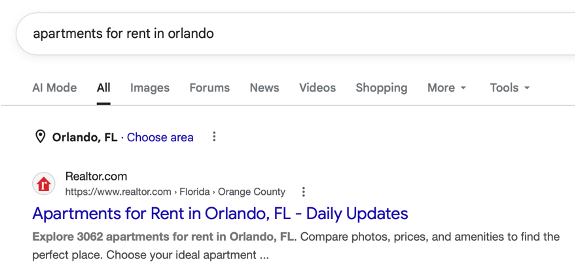
The same thing happens when searching "apartments for rent in Orlando." Realtor.com ranks highly with a page titled "Apartments for Rent in Orlando, FL."

This is not a coincidence.
By including relevant keywords in page titles and headings, Realtor.com makes it easier for search engines to understand what each page is about.
Why This Works
After clicking the search result, the optimization continues.
The page heading reinforces the same topic, and the content focuses specifically on homes or apartments in that location.
Everything works together:
Search query
Page title
Heading
Content
This alignment helps search engines determine that the page is highly relevant to the user's search.
Small Changes Can Make a Big Difference
Many people assume SEO is highly technical, but some of the most effective improvements are surprisingly simple.
Creating descriptive page titles, organizing content with headings, and naturally using relevant keywords can help search engines better understand your website.
Over time, these improvements can increase visibility and attract more organic traffic.
Final Thoughts
On-page SEO is one of the most important parts of any digital marketing strategy. It helps search engines understand your content while making your website easier for visitors to use.
The Realtor.com example shows that successful SEO is not about tricking search engines. It is about clearly communicating what a page offers and matching it with what users are searching for.
When businesses focus on relevance and user experience, they create a stronger foundation for long-term online growth.


Comments